GEOTECHNICAL ENGINEERING
CORK
HomeGround improvementVibrocompaction design

Vibrocompaction Design That Works With Cork’s Ground Conditions

Geotechnical engineering with regional judgment.

LEARN MORE

Cork grew from a marshy trading post on the River Lee into a modern city, and the ground beneath it still carries that history. Much of the city centre and docklands sits on soft alluvial silts and loose sands over Devonian sandstone. We see it on nearly every urban redevelopment: three to eight metres of compressible material that simply cannot support structural loads without treatment. Vibrocompaction design steps in where standard compaction cannot reach. The process uses depth vibrators to rearrange granular particles into a denser state, and the design phase determines exactly how deep, how tight, and at what spacing the probes must work. Without that upfront engineering, the treatment is just guesswork. On the north side quays, where the infill is highly variable, we often pair vibrocompaction design with CPT testing to verify density improvement after each probe pass, giving the structural engineer confidence that bearing capacity targets are met.

The design is only as good as the verification. On Cork’s alluvial sands, we rely on CPT before-and-after profiles because standard SPT blow counts miss thin loose seams.
Our service areas

Our approach and scope

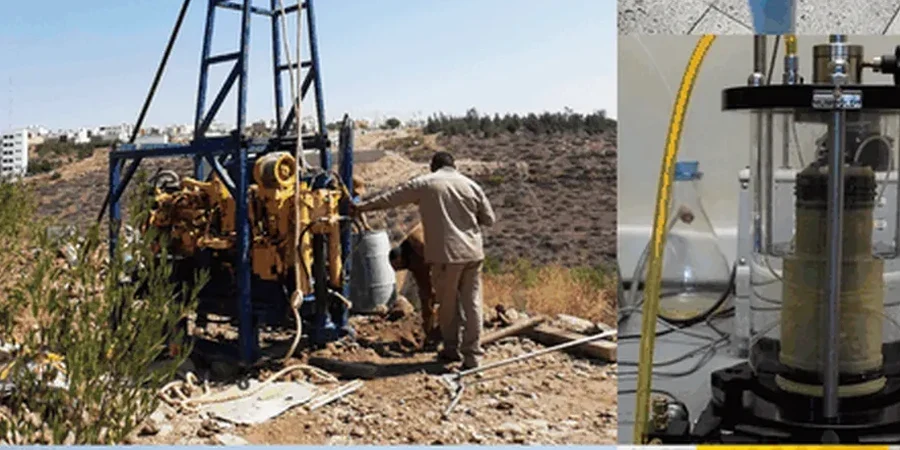
The equipment we specify for Cork jobs is typically a top-feed depth vibrator mounted on a crawler crane or excavator leader. It delivers horizontal vibrations through eccentric weights spinning inside a steel probe, compacting the surrounding soil outward in radial influence zones. The design defines three critical parameters: probe spacing on a triangular or square grid, vibration frequency adjusted to the soil’s natural response, and stage withdrawal rate. Get any of these wrong and you leave untreated lenses in the ground. On a recent project near the Marina, the design called for 1.8-metre probe centres through hydraulically placed sand fill, followed by a second pass where the stone columns crew would later install drainage elements. The probe itself reaches depths of 15 to 20 metres, sufficient to punch through Cork’s typical soft layer and seat into the underlying glacial till. Power consumption is monitored continuously. A drop in amperage signals the sand has reached refusal density and the probe can advance. It is a direct feedback loop between the design assumptions and what the ground actually gives back.
Vibrocompaction Design That Works With Cork’s Ground Conditions
Technical reference — Cork

Site-specific factors

Cork’s subsurface risk is dominated by the Lee valley alluvium: loose saturated sands interbedded with soft silt and occasional peat lenses. Groundwater sits barely two metres below street level across much of the island city. In a seismic event, even a moderate one by Irish standards, loose saturated sand can liquefy and lose all bearing capacity in seconds. The National Annex to Eurocode 8 classifies Cork in a low-to-moderate seismicity zone, but the combination of high water table and granular fill makes the liquefaction hazard real for critical infrastructure. We design vibrocompaction grids specifically to mitigate that risk. Probe spacing tightens near quay walls and bridge abutments. The design also accounts for the vibration radius of influence relative to adjacent structures. On cramped city centre sites, we model settlement troughs and set vibration monitoring trigger levels before the first probe goes in. It is not just about density. It is about protecting what is already standing.

Need a geotechnical assessment?

Reply within 24h.

Email: contact@geotechnical-engineering.co

Applicable standards

IS EN 1997-1:2005 (Eurocode 7 Part 1), IS EN 1997-2:2007 (Eurocode 7 Part 2, ground investigation and testing), IS EN 1998-1:2005 (Eurocode 8 Part 1, seismic design) with Irish National Annex, IS EN 14731:2005 (Execution of special geotechnical work: ground treatment by deep vibration), Specification for Ground Treatment (Institution of Civil Engineers, UK, commonly referenced in Irish practice)

Reference parameters

ParameterTypical value
Typical treatment depth in Cork alluvium8 m to 18 m
Probe grid patternTriangular, 1.5 m to 2.5 m centres
Target relative density after treatment≥ 70% (Dr)
Vibration frequency range30 Hz to 50 Hz
Applicable grain size envelope0.075 mm to 80 mm
Pre/post verification methodCPT or SPT per Eurocode 7
Groundwater correction factorApplied per IS EN 1997-2

Frequently asked questions

How much does vibrocompaction design cost for a typical Cork city centre site?

For a site investigation, design package, trial zone specification, and post-treatment verification, the engineering fee typically falls between €1,220 and €4,760 depending on site size, access constraints, and the number of verification tests required. A cramped infill site near quay walls costs more to instrument than an open greenfield plot.

What soil types in Cork are suitable for vibrocompaction?

Vibrocompaction works on granular soils with less than 10 to 12 percent fines content. The loose alluvial sands and hydraulically placed fill found across the Lee valley and docklands are ideal. It is not effective in the soft silts and peat lenses also common in Cork; those require stone columns or rigid inclusions instead.

How do you protect neighbouring buildings during deep vibration works in Cork?

We start with a pre-condition survey of all structures within the zone of influence, typically 15 to 20 metres from the outermost probe. Vibration monitors are placed on sensitive walls and foundations. The design sets peak particle velocity limits, and if readings approach the threshold we reduce probe frequency or switch to a slower withdrawal rate. On one Cork quay project, we kept vibration below 5 mm/s at a 19th-century warehouse just 6 metres from the treatment grid.

How long does the design and verification process take for a vibrocompaction project?

The design phase, starting from receipt of the ground investigation data, usually takes two to three weeks. The trial zone and verification testing run alongside the main compaction works. From first probe to final compliance report, a 1,500-square-metre Cork site typically completes the full design-verify cycle in four to five weeks, weather permitting.

Location and service area

We serve projects in Cork and surrounding areas.

View larger map