GEOTECHNICAL ENGINEERING
CORK
HomeLaboratoryLaboratory CBR test

Laboratory CBR Testing in Cork: Accurate Subgrade Strength for Pavement Design

Geotechnical engineering with regional judgment.

LEARN MORE

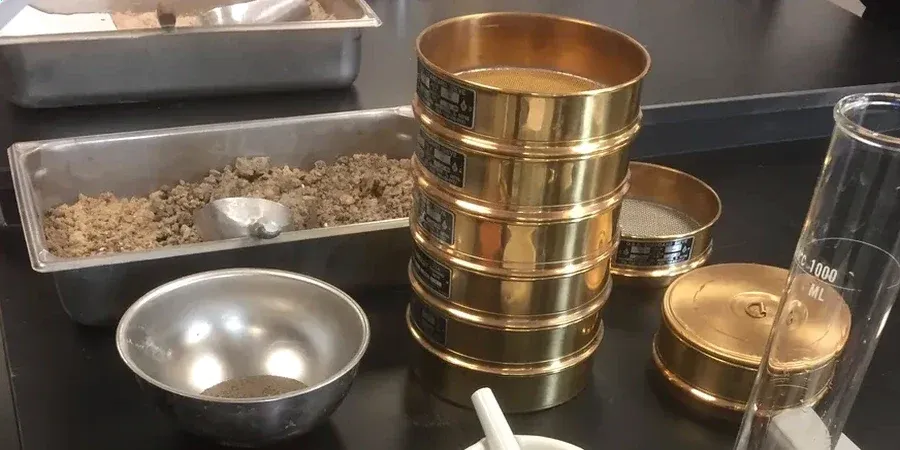
Cork sits on a floodplain of the River Lee, much of its city centre built on alluvial silts and soft marls that complicate any road project. With over 220,000 people in the metropolitan area, the demand for durable pavements is constant, and that durability starts with the subgrade. The laboratory CBR test gives us a direct measurement of the soil's bearing capacity, a value that dictates pavement thickness, capping layer requirements, and aggregate selection. Our team runs the test inside a temperature-controlled chamber, compacting remoulded specimens at optimum moisture content to mirror site conditions as closely as possible. For sites east of the city on the more gravelly limestone tills, we often pair the CBR data with a grain-size analysis to confirm the fines content before finalising the pavement design, a step that avoids over-design and keeps the construction budget in check.

A soaked CBR value below 2% is not a failure report; it is the earliest cost-saving signal a pavement designer gets.
Our service areas

Our approach and scope

The contrast between the sandstone-derived soils of the western suburbs and the estuarine clays near the Marina is stark. A material that looks competent in the field can lose half its strength when saturated, a shift we capture by running the CBR test at both the optimum moisture content and after a four-day soak. This procedure, aligned with I.S. EN 13286-47, produces a soaked CBR value that is the real design input for Irish conditions. Our laboratory compacts specimens in five layers using a 4.5 kg rammer, measuring swell during soaking and penetration resistance up to 7.5 mm with a calibrated proving ring. When the soaked result falls below 2%, the subgrade alone cannot support traffic loads and needs stabilisation or a thicker capping layer. In those scenarios, the CBR curve combined with a plate-load-test on the compacted formation helps the contractor verify that the specified modulus has been reached before laying the first bound course.
Laboratory CBR Testing in Cork: Accurate Subgrade Strength for Pavement Design
Technical reference — Cork

Site-specific factors

The damp maritime climate of Cork, with over 1,200 mm of annual rainfall, means that subgrade soils are rarely dry during construction. A CBR test run only on unsoaked specimens gives a dangerously optimistic picture, one that can lead to rutting within the first winter of service. The real risk is not the low number itself but the decision to ignore the soaked value. We have seen crushed-rock capping layers specified on the basis of a CBR of 8% from a dry sample when the soaked equivalent was barely 1.5%, a gap that no amount of compaction will close. The soaked CBR anchors the entire pavement catalogue from the TII NRA Series 600 and 800 documents, and skipping it because of programme pressure is a liability that no contractor in Cork should carry.

Need a geotechnical assessment?

Reply within 24h.

Email: contact@geotechnical-engineering.co

Applicable standards

I.S. EN 13286-47:2021 – Unbound and hydraulically bound mixtures: Test method for the determination of California bearing ratio, TII Publication CC-SPW-01200 – Specification for Road Works Series 600: Earthworks, I.S. EN 13286-2 – Test methods for the determination of dry density/water content relationship (Proctor)

Reference parameters

ParameterTypical value
Test standardI.S. EN 13286-47:2021
Specimen compaction methodProctor (2.5 kg or 4.5 kg rammer)
Mould dimensionsCBR mould, 152 mm diameter, 178 mm height
Soaking period96 hours (4 days) under 4.5 kg surcharge
Penetration rate1.27 mm/min, measured at 2.5 mm and 5.0 mm
Typical sample mass required25 kg of air-dried soil passing 20 mm sieve
Reported valuesCBR at 2.5 mm, CBR at 5.0 mm, swell percentage

Frequently asked questions

How much does a laboratory CBR test cost in Cork?

A single-point soaked CBR test, including the Proctor reference and the four-day soaking period, runs between €100 and €210. The exact figure depends on whether the material needs pre-treatment, the number of compaction points requested, and the turnaround time. For a combined Proctor-CBR package with three compaction points, the upper end of that range applies. We send a written quotation once we know the material type and the number of specimens.

What size sample do I need to send to the Cork lab?

We ask for at least 25 kg of air-dried soil passing the 20 mm sieve. If the material contains particles larger than 20 mm, a scalping procedure is applied and the oversized fraction is reported. For stabilised materials, the sample must arrive in sealed buckets within 24 hours of mixing so that curing can start under controlled conditions in our humidity room.

Which CBR value matters for the pavement design, the one at 2.5 mm or at 5.0 mm?

The standard I.S. EN 13286-47 requires that both values be reported. The design value is the higher of the two. If the CBR at 5.0 mm exceeds the value at 2.5 mm, the test must be repeated. In practice, for most fine-grained soils in Cork, the 2.5 mm value governs, but we always include both in the certificate so the designer can check compliance with the TII specification.

Location and service area

We serve projects in Cork and surrounding areas.

View larger map