GEOTECHNICAL ENGINEERING
CORK
HomeSlopes & WallsActive/passive anchor design

Active and Passive Anchor Design in Cork

Geotechnical engineering with regional judgment.

LEARN MORE

Cork’s topography, carved by the River Lee and its 30-plus bridges, creates unique challenges for any excavation deeper than four meters. The city sits at just 8 meters above sea level, with a population of over 224,000, and much of the commercial core rests on soft alluvial silts and glacial tills. When a basement dig in the docklands or a cut-and-cover tunnel near Kent Station runs into groundwater, passive soil resistance alone rarely suffices. Anchor design becomes the controlling factor for wall stability and adjacent building protection. Our team applies the limit-state philosophy of Eurocode 7 to every anchor design, balancing prestress levels, free length, and bond zone geometry against Cork’s layered subsurface. For deeper profiles we often correlate data from a CPT test to refine the soil parameters used in anchor load calculations, avoiding conservative over-design.

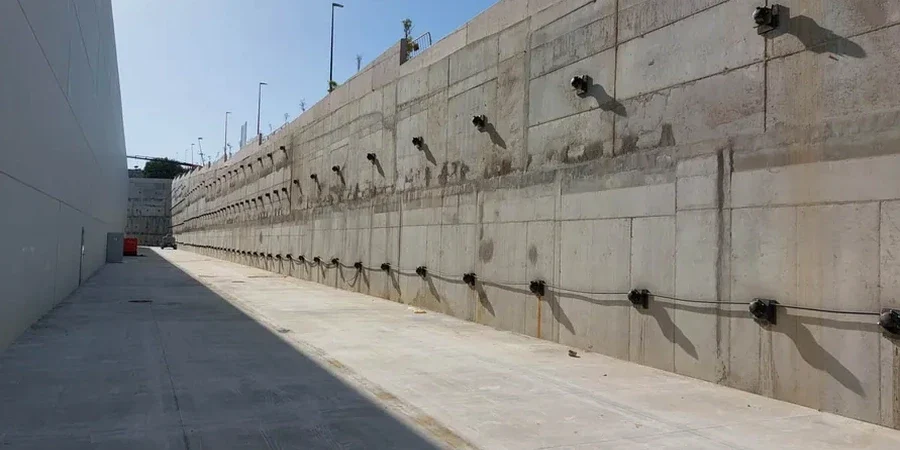
A properly designed anchor system does more than hold back soil — it limits wall deflection to under 0.2% of the retained height, protecting adjacent historic structures.
Our service areas

Our approach and scope

The quaternary sediments beneath Cork city center alternate between soft estuarine clay, loose sand lenses, and the underlying Glenville Formation sandstone — a profile that demands careful anchor bond length verification. An active anchor transfers load through a stressed tendon before soil movement occurs, while a passive anchor engages only after the wall displaces. In the silty clays near the South Channel, passive resistance can be as low as 60 kPa. The technical work involves calculating the Rankine or Coulomb earth pressure envelope, selecting the unbonded length to place the grout bulb beyond the failure wedge, and designing the tendon head to accommodate lock-off loads under serviceability conditions. Compliance with IS EN 1997-1:2005 and the Irish Annex NA is non-negotiable; we also reference the guidance in CIRIA C760 for anchored retention systems.
Active and Passive Anchor Design in Cork
Technical reference — Cork

Site-specific factors

The ground conditions between the north-side Blackpool area and the south-side Douglas suburb illustrate exactly why anchor design cannot be generalized. Blackpool sits on dense glacial boulder clay with high bond capacity, where anchors perform predictably with short bond lengths. Douglas, closer to the estuary, transitions into soft compressible silt — a material prone to creep under sustained load. Designing the same anchor configuration for both sites would be negligent. The main risk vector is progressive anchor relaxation in low-permeability soils, where pore water pressure equalization around the grout bulb takes weeks. Without staged stressing and long-term monitoring, a retaining wall can drift outward by 30 millimeters or more, cracking pavement and pulling on adjacent utility trenches. We mitigate this through investigation-level anchor testing and by specifying encapsulated tendons where the water table sits within two meters of the anchor head.

Need a geotechnical assessment?

Reply within 24h.

Email: contact@geotechnical-engineering.co

Applicable standards

IS EN 1997-1:2005 (Eurocode 7: Geotechnical design), IS EN 14490:2010 (Execution of special geotechnical works — Soil nailing), CIRIA C760 (Guidance on embedded retaining wall design), Institution of Structural Engineers — Temporary Works Design Guide

Reference parameters

ParameterTypical value
Design bond stress (stiff clay)200-400 kPa
Free tendon length minimum4.5 m per IS EN 1997
Proof load factor (acceptance test)1.25 x service load
Lock-off load range80-100% of design load
Creep rate limit (investigation test)< 2 mm per log cycle
Typical anchor inclination15°-30° from horizontal

Frequently asked questions

What does active/passive anchor design cost for a Cork city centre project?

Anchor design fees typically range from €1,000 to €3,370 depending on the number of anchor levels, wall length, and whether investigation tests are required. A single-level tie-back system for a standard 30-meter wall falls at the lower end, while multi-level permanent anchors with DCP protection and full testing supervision move toward the upper range.

How deep can an anchored wall go in Cork's estuarine soils?

There is no fixed limit, but practical experience in the docklands shows single-level anchors supporting cuts up to 6 meters, while two or three levels can retain 12 to 15 meters. The controlling factor is the depth to competent bearing stratum — usually the Glenville Formation sandstone — and the available bond length below the active failure wedge.

What is the difference between an investigation test and a suitability test for anchors?

An investigation test loads a sacrificial anchor to failure to establish the ultimate geotechnical capacity. A suitability test proves that the construction method can achieve the required working load in a specific soil layer without exceeding creep limits. Both are mandated by IS EN 1997 before production anchoring begins.

Location and service area

We serve projects in Cork and surrounding areas.

View larger map