GEOTECHNICAL ENGINEERING
CORK
HomeLaboratoryAtterberg limits

Atterberg Limits Testing in Cork: Reliable Soil Classification

Geotechnical engineering with regional judgment.

LEARN MORE

Cork's development history is written in its river channels. The city expanded by draining marshes and infilling the many branches of the River Lee. This means today's construction sites often sit on estuarine silts and clays. These soils change volume with moisture. They swell when wet and shrink when dry. Atterberg limits testing is the definitive method to quantify this behavior. We determine the boundaries between liquid, plastic, and solid states. The data feeds directly into foundation design. It also informs earthworks specifications. Without it, a contractor is guessing about the ground's seasonal movement. Our laboratory runs these tests under I.S. EN ISO 17892-12. We serve geotechnical consultancies and civil contractors across Cork city and the wider county. The results you receive are clear, repeatable, and legally defensible.

Knowing the plasticity index of Cork's estuarine clays is the difference between a foundation that moves and one that stays put.
Our service areas

Our approach and scope

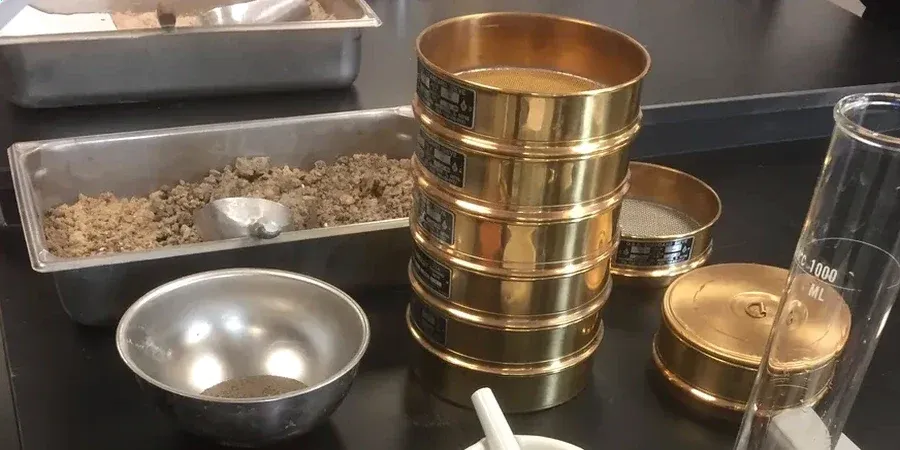
Cork sits just a few meters above sea level. Much of the city center is built on soft alluvium. This low elevation makes groundwater a constant factor. The soil moisture content rarely stabilizes. That is why Atterberg limits matter. The liquid limit tells you the water content where the soil flows. The plastic limit defines where it crumbles. The difference is the plasticity index. A high index in Cork's silty clays signals high shrink-swell potential. This directly impacts road subgrades and shallow foundations. We complement this with a grain size analysis to confirm the full particle distribution. The test uses the Casagrande cup method and the rolling thread technique. Each step follows the standard precisely. The result is not just a number. It is a classification that unlocks the correct design parameters per Eurocode 7.
Atterberg Limits Testing in Cork: Reliable Soil Classification
Technical reference — Cork

Site-specific factors

A six-story apartment block was going up near the South Docks. The initial site investigation skipped Atterberg testing. The design assumed a low-plasticity silt. About eight months after handover, cracks appeared in the ground-floor slabs. A follow-up investigation revealed high-plasticity estuarine clay underneath. The clay had shrunk during a dry summer. The repair bill ran deep. This scenario is preventable. Atterberg limits testing flags these clays before the first pile is driven. Cork's tidal river zones are particularly prone to these deposits. The plasticity index also feeds into empirical correlations for undrained shear strength. It is a small test with an outsized impact on risk management. We advise running it on every cohesive sample recovered from boreholes and test pits in the city center.

Need a geotechnical assessment?

Reply within 24h.

Email: contact@geotechnical-engineering.co

Applicable standards

I.S. EN ISO 17892-12:2018, Eurocode 7 (I.S. EN 1997-2:2007), NRA MCDRW (for road subgrade classification), BS 1377-2:1990 (reference historical context)

Reference parameters

ParameterTypical value
Liquid Limit (LL)Water content at transition from plastic to liquid state
Plastic Limit (PL)Water content at transition from semi-solid to plastic state
Plasticity Index (PI)LL - PL; indicates soil reactivity range
Test StandardI.S. EN ISO 17892-12:2018
Sample Mass RequiredMinimum 500 g passing 425 µm sieve
Reporting FormatNumerical results with Casagrande plasticity chart classification
Typical Turnaround3-5 working days from sample receipt

Frequently asked questions

What exactly are the Atterberg limits?

The Atterberg limits define the water content boundaries between different soil consistency states. The liquid limit marks the transition from plastic to liquid. The plastic limit marks the transition from semi-solid to plastic. The shrinkage limit is the boundary below which the soil volume stops decreasing. These values are used to classify fine-grained soils and predict their engineering behavior.

Why is this test critical for Cork construction sites?

Cork city center is built on reclaimed marshland and estuarine alluvium from the River Lee. These deposits contain high-plasticity clays that shrink and swell significantly with seasonal moisture changes. The Atterberg limits quantify this reactivity. This allows structural engineers to design foundations that can accommodate the movement or bypass the active zone entirely.

How much does Atterberg limits testing cost in Cork?

Testing typically ranges from €60 to €100 per sample, depending on whether you need just the liquid and plastic limits or the full set including natural moisture content and liquidity index calculation. We provide a formal quotation based on the number of samples and the required reporting detail.

How long does the test take?

The laboratory procedure itself takes one to two days, including the drying, sieving, and the actual percussion cup and rolling thread tests. We typically report results within 3 to 5 working days. Expedited service is available for time-sensitive projects.

What sample quality is needed?

We need disturbed samples, so sample quality is less critical than for strength tests. A minimum of 500 grams of soil passing the 425 µm sieve is required. The sample should be representative of the cohesive layer in question. We can sieve and prepare the material in our Cork laboratory.

Location and service area

We serve projects in Cork and surrounding areas.

View larger map