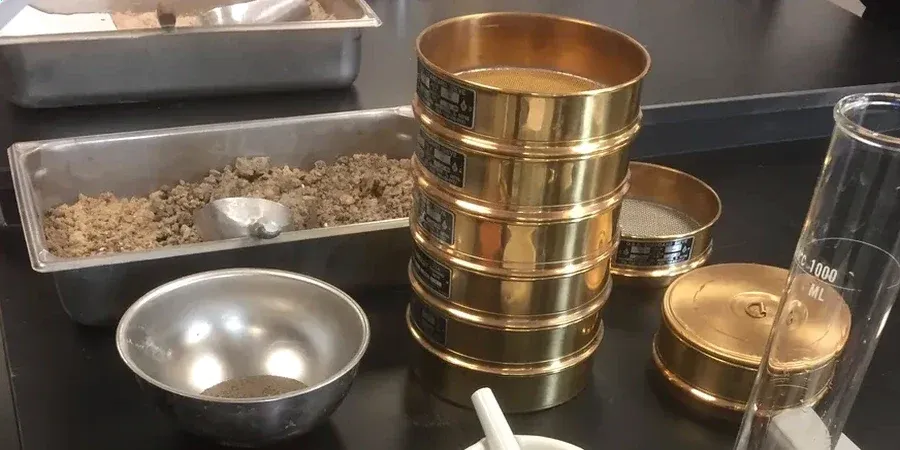
On a recent project down by the Marina, a contractor hit a lens of fine silt right where the borehole log showed gravelly sand. The foundation design assumed free-draining material, but the grain size distribution told a different story—one that required a complete rethink of the drainage strategy. That is exactly why a full grain size analysis combining sieve and hydrometer is non-negotiable in Cork, where the glacial and alluvial deposits can flip from coarse to fine within a few metres. Our laboratory runs the complete curve from 63 mm down to the 2-micron clay fraction, following IS EN ISO 17892-4:2016, so the design team gets a single, coherent dataset that feeds directly into permeability estimates, frost susceptibility checks, and soil classification per the Irish Annex of Eurocode 7. For deep excavations in the Lee valley, we often pair the hydrometer results with Atterberg limits to nail down the plasticity range of the silty clays that dominate the city centre quaternary sequence.
A single grain size curve from 63 mm cobbles down to 2-micron clay particles removes the guesswork from Cork's layered glacial soils.