GEOTECHNICAL ENGINEERING
CORK
HomeIn-Situ TestingField density test (sand cone method)

Field Density Testing (Sand Cone Method) in Cork — Reliable In-Situ Compaction Control

Geotechnical engineering with regional judgment.

LEARN MORE

Cork's expansion from a medieval trading port on the River Lee's marshy islands into a modern city has left a layered subsurface that keeps even seasoned groundworkers on their toes. The city centre sits largely on reclaimed estuarine silts and peats, while the northern suburbs climb into glacial tills over Carboniferous limestone. When an earthworks subbie compacted a service trench on Curraheen Road last winter, the sandstone fill passed visual inspection but failed density testing at three of seven stations — soft spots that would have settled within a year. That scenario replays itself across Douglas, Ballincollig, and Blackpool whenever fill placement outruns verification. The sand cone test catches these failures before the asphalt goes down, giving the project engineer a number — not an opinion — on compaction compliance. For road base acceptance under the city council's Taking in Charge process, or for a warehouse pad in Blarney Business Park where forklift point loads punish differential settlement, we run the test strictly to I.S. EN 13286-4:2021 with calibrated sand that arrives on site sealed and pre-weighed. Complementing the density check with a CBR road investigation early in the design phase helps the pavement designer confirm the subgrade strength assumed in the structural section — a pairing that Cork's wet winters make particularly sensible.

A visual inspection won't tell you if the fill hits 95% modified Proctor — the sand cone gives you a number you can defend to the resident engineer.
Our service areas

Our approach and scope

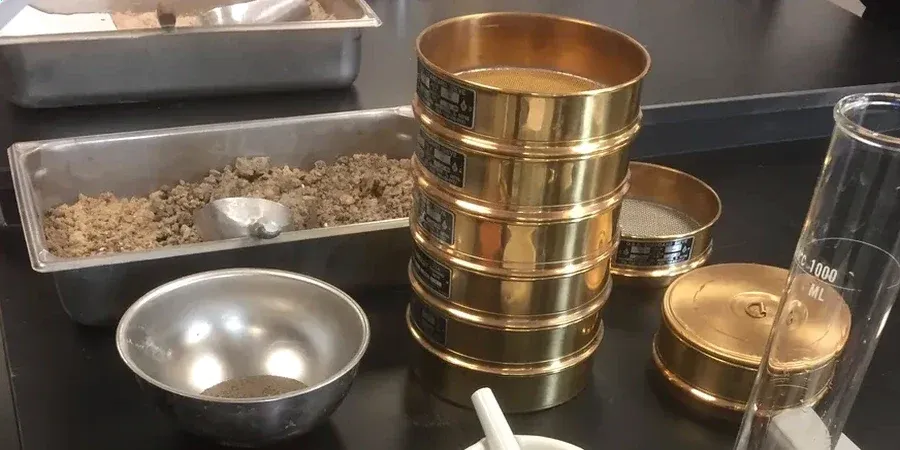
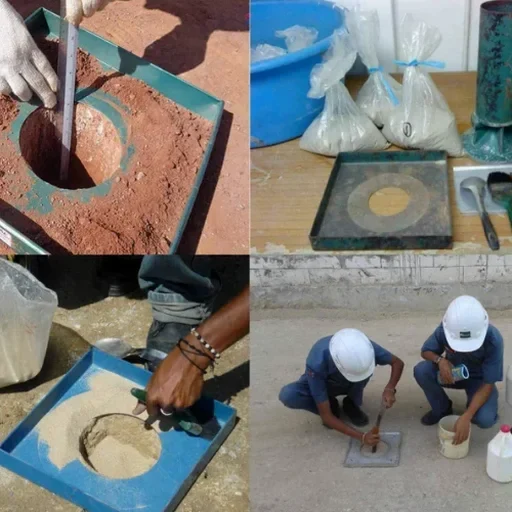
The most common mistake we see around Cork is accepting a single density reading per lift on a 40-metre trench run and calling it compliant. Compaction varies laterally more than vertically, especially in mixed fills sourced from two quarries. A haul truck loaded with clean limestone from Ovens might be followed by a load of silty gravel from a site in Glanmire, and the compaction behaviour shifts. The sand cone method shines here because it tests a representative volume — typically the top 150 mm of a compacted lift — and produces a direct measurement of in-place dry density without relying on nuclear gauge calibrations that drift in heterogeneous material. We run the test using graded Ottawa-type sand with a calibrated density cone and a base plate seated flush on a level surface, excavating carefully to avoid disturbing the hole walls. The moisture content sample goes straight into a sealed container for oven drying back at our Cork lab, so the dry density calculation accounts for actual field moisture rather than an assumed value. When the spec calls for 95% modified Proctor on a structural fill beneath a shallow footing, the sand cone gives the contractor an immediate pass-fail result; if it fails, we can re-test after additional roller passes without waiting on remote lab turnaround. In granular soils typical of the Glacial Till that mantles much of the north side, the hole stability is generally good, though in loose sands near the Lee we sometimes need to template the excavation. The method's main limitation is depth — it's a near-surface test — so for deeper fill quality assurance on thick embankments we recommend pairing it with CPT sounding to profile density trends continuously through the full lift thickness.
Field Density Testing (Sand Cone Method) in Cork — Reliable In-Situ Compaction Control
Technical reference — Cork

Site-specific factors

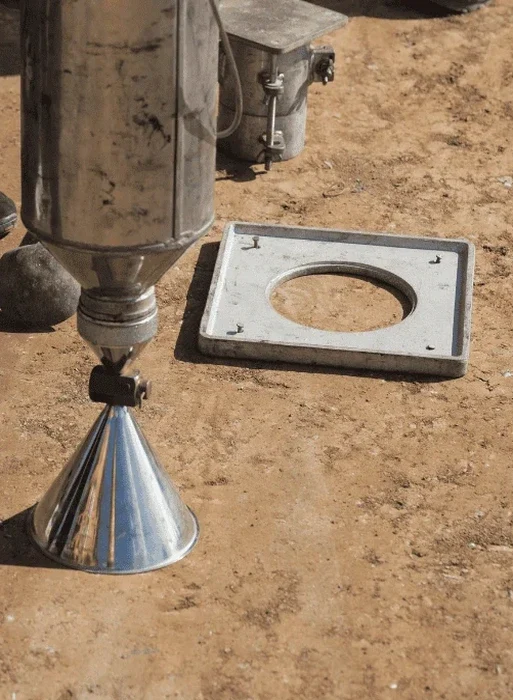
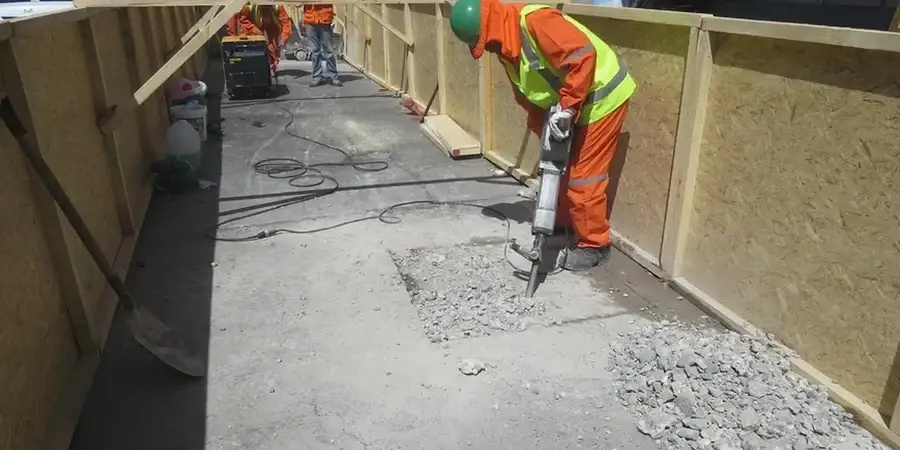
The sand cone kit is deceptively low-tech — a one-gallon plastic jar, a metal cone with a valve, a base plate, and a bag of calibrated sand — but the physical demands of running it properly on a Cork winter morning separate a trustworthy result from a box-ticking exercise. The operator carries the kit onto a compacted lift that might be exposed to a drizzle off the harbour, kneels down on damp crushed rock, and excavates a precise cylindrical hole using a chisel and spoon, bagging every gram of spoil without losing fines to the wind. If the base plate rocks on a coarse aggregate particle, or if the operator vibrates the sand jar inadvertently while opening the valve, the density calculation shifts enough to swing a pass-fail decision. Cork's climate adds a layer of difficulty: high relative humidity can cause the calibration sand to absorb moisture and change its bulk density over the course of a day, so we re-calibrate more frequently here than in drier climates. The biggest risk is skipping the test entirely on small jobs — a house extension in Rochestown, a driveway in Glounthaune — because the contractor assumes the plate compactor did the job. Six months later the paving sinks 30 mm, water ponds against the dwelling, and the repair costs dwarf what the density testing would have cost. For structural backfill to retaining walls along the N40 cuttings, retaining wall monitoring combined with density verification gives the designer confidence that lateral earth pressures match the assumptions in the wall design.

Need a geotechnical assessment?

Reply within 24h.

Email: contact@geotechnical-engineering.co

Video overview

Applicable standards

I.S. EN 13286-4:2021 — Unbound and hydraulically bound mixtures — Test method for dry density and water content (sand cone method), I.S. EN 13286-2:2010 — Proctor compaction reference (laboratory dry density/water content relationship), I.S. EN 1097-5:2008 — Determination of water content by drying in a ventilated oven, NRA (TII) Series 600 — Earthworks (Specification for Road Works)

Reference parameters

ParameterTypical value
Test standardI.S. EN 13286-4:2021
Measured parameterIn-place dry density (kg/m³)
Test depth rangeTop 150–200 mm of compacted lift
Hole diameter100–150 mm (material dependent)
Calibration sandGraded silica sand, bulk density calibrated on site
Moisture content methodOven-dried at 105±5°C per I.S. EN 1097-5
Result format% relative compaction vs. lab reference (Proctor/vibrating hammer)
Typical frequency1 test per 500 m² per compacted lift (or per spec)

Frequently asked questions

How much does a sand cone field density test cost in Cork?

A single sand cone density test on a Cork site typically runs between €100 and €120, depending on the number of stations, travel distance, and whether a laboratory Proctor reference is already available. For larger projects with multiple tests per day the per-unit cost drops. We provide a fixed-price quote after reviewing the spec and the site location — no hidden call-out fees.

How many sand cone tests do I need for a typical Cork house foundation?

For a single dwelling on a compacted granular fill pad, the standard rule of thumb is one test per lift per 500 m² or one per foundation footprint, whichever is more stringent. Most house plots in Cork suburbs like Carrigaline or Glanmire end up needing three to five tests across the building footprint and driveway area to satisfy the assigned certifier. The exact frequency should be stated in the project's earthworks specification.

Can the sand cone test be used on coarse crushed stone with 40 mm aggregate?

The sand cone method works best on material with a maximum particle size up to about 37.5 mm. On coarse crushed limestone (e.g., 804 clause material commonly used in Cork road construction), the excavated hole diameter should be increased to at least 150 mm to reduce the influence of individual large particles on the density calculation. For very coarse rockfill with cobbles, a replacement method using a larger volume (water replacement or large-scale pit test) is more appropriate.

What's the difference between the sand cone test and a nuclear density gauge?

The sand cone is a direct measurement: you excavate soil, weigh it, measure the hole volume with calibrated sand, and calculate density from mass and volume. A nuclear gauge estimates density indirectly by measuring gamma radiation backscatter or transmission through the soil — fast, but it requires calibration against a known density block and can drift in heterogeneous Cork glacial tills. The sand cone is the referee method. If a nuclear gauge reading is disputed, the sand cone result generally decides the argument.

Location and service area

We serve projects in Cork and surrounding areas.

View larger map