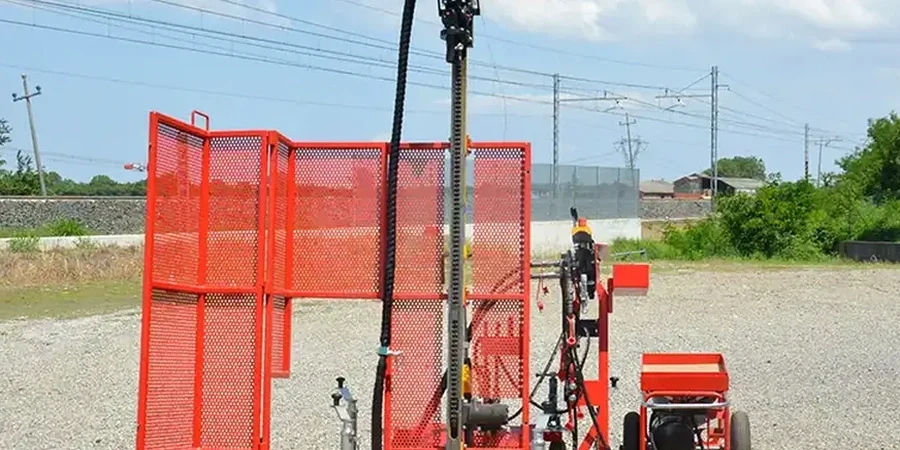
Cork sits on a complex foundation of Carboniferous limestone overlain by glacial tills, alluvium, and pockets of soft estuarine clay along the River Lee valley. Borehole records from the city centre regularly encounter 3 to 8 metres of made ground before hitting natural deposits, with groundwater appearing as shallow as 1.5 metres in low-lying areas near the South Channel. The SPT (Standard Penetration Test) remains the most practical tool for quantifying the relative density of these granular tills and the consistency of the underlying cohesive layers. We mobilise a tracked Terrier 2002 rig fitted with an automatic trip hammer calibrated to BS EN ISO 22476-3:2005, ensuring every blow count translates to a defensible N60 value. For sites in the Mardyke or Blackpool areas where peat lenses complicate the stratigraphy, we combine the SPT programme with a CPT test to cross-verify undrained shear strength profiles and identify thin soft seams that a split-spoon sampler might miss.
In Cork's glacial till, SPT refusal often occurs within 6 metres on the north side of the Lee, yet the south bank can require 15 metres of driving before encountering competent limestone.