GEOTECHNICAL ENGINEERING
CORK
HomeGround improvementGrouting design

Grouting Design in Cork: Ground Stabilization for Challenging Irish Soils

Geotechnical engineering with regional judgment.

LEARN MORE

A developer we worked with near the Marina had a site riddled with voids in the limestone, a classic Cork headache where the underlying geology can swallow concrete without a trace. Grouting design in Cork is not a one-mix-fits-all exercise; it demands a targeted approach that considers the karstic bedrock and the soft alluvial silts deposited by the River Lee. The city's expansion onto former marshland and docklands means you are frequently dealing with highly variable ground, and a poorly designed injection program can lead to significant material loss and schedule delays. Our technical team maps out a grouting plan that stabilizes the subsurface before foundations go in, integrating stratigraphic data from in-situ permeability testing to select the right mix rheology and injection pressure for each distinct layer.

A well-designed grout curtain in Cork's karst does more than fill a void—it redirects groundwater flow and prevents future dissolution of the rock mass.
Our service areas

Our approach and scope

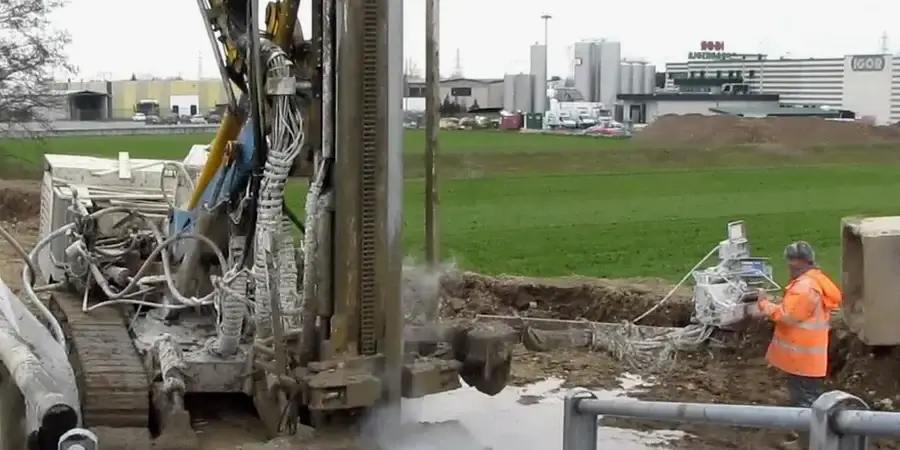
The equipment configuration we deploy on Cork jobsites typically centers on colloidal mixer plants paired with high-pressure piston pumps capable of delivering up to 100 bar at the nozzle, which is essential when you need to push cement-bentonite mixes into tight fissures within the Waulsortian limestone. We monitor injection parameters in real time—flow rate, pressure, and volume—through digital data loggers mounted directly on the rig, allowing the site engineer to adjust the refusal criteria on the fly if the ground takes more grout than the initial geological model predicted. This setup is particularly effective in the Glanmire and Douglas areas where the transition from sandstone to limestone can be sharp, and split-spacing injection sequences often prove more reliable than single-phase filling. The entire process aligns with IS EN 12715:2020 for execution of grouting works, ensuring traceability from batch plant to injection point.
Grouting Design in Cork: Ground Stabilization for Challenging Irish Soils
Technical reference — Cork

Site-specific factors

The most frequent mistake we see on Cork sites is treating grouting as a simple pumping operation without a proper hydrogeological assessment. Contractors sometimes assume a single-stage penetration grout will seal everything, but in the Lee valley's layered deposits you often need a combination of permeation grouting in the sands and compaction grouting in the softer silts to achieve a uniform improvement. Skipping the Lugeon water pressure tests before injection leaves you blind to the actual connectivity of the fissures, and the result is grout traveling dozens of meters off-site into unintended zones—something that gets expensive and environmentally messy very quickly. A detailed grouting program also protects against differential settlement when the new structure bridges between a compact gravel terrace and the compressible estuarine clays that underpin much of the city center.

Need a geotechnical assessment?

Reply within 24h.

Email: contact@geotechnical-engineering.co

Reference standards

IS EN 12715:2020 – Execution of special geotechnical work – Grouting, Eurocode 7 (IS EN 1997-1:2004) – Geotechnical design, IS EN 1997-2:2007 – Ground investigation and testing, NRA TB 14 – Grouting for ground improvement (National Roads Authority guidance)

Reference parameters

ParameterTypical value
Injection pressure range5–100 bar
Common mix typeCement-bentonite, microfine cement
Marsh funnel viscosity target35–45 seconds
Bleed limit (3 hr)< 2% per IS EN 12715
Hole spacing (primary grid)1.5–3.5 m depending on Lugeon value
Lugeon threshold for treatment> 5 Lugeon units
Curing time before coringMinimum 28 days

Quick answers

How much does a grouting design package cost for a typical Cork residential site?

For a single-family home site in Cork with moderate limestone risk, a full grouting design—including geological review, Lugeon testing specification, mix design, and on-site supervision of injection—ranges from €990 to €4,210 depending on the number of boreholes and the complexity of the void network.

What is a Lugeon test and why is it necessary before grouting in Cork?

A Lugeon test measures the water take in a section of borehole under pressure, giving you a direct reading of how fractured or open the rock mass is around Cork's limestone bedrock. Without it, you have no reliable way to set the grout hole spacing or to decide between microfine and standard cement, which means your injection program is essentially guesswork.

Can grouting fix settlement issues in an existing building on the Lee alluvium?

In many cases, yes. If the settlement is linked to loose silts or sand lenses beneath the foundation, a carefully designed compaction grouting program can densify those layers and arrest further movement. Every job starts with a review of the original ground investigation and a targeted borehole campaign to confirm the depth and extent of the weak zone before we commit to an injection grid.

Location and service area

We serve projects in Cork and surrounding areas.

View larger map